
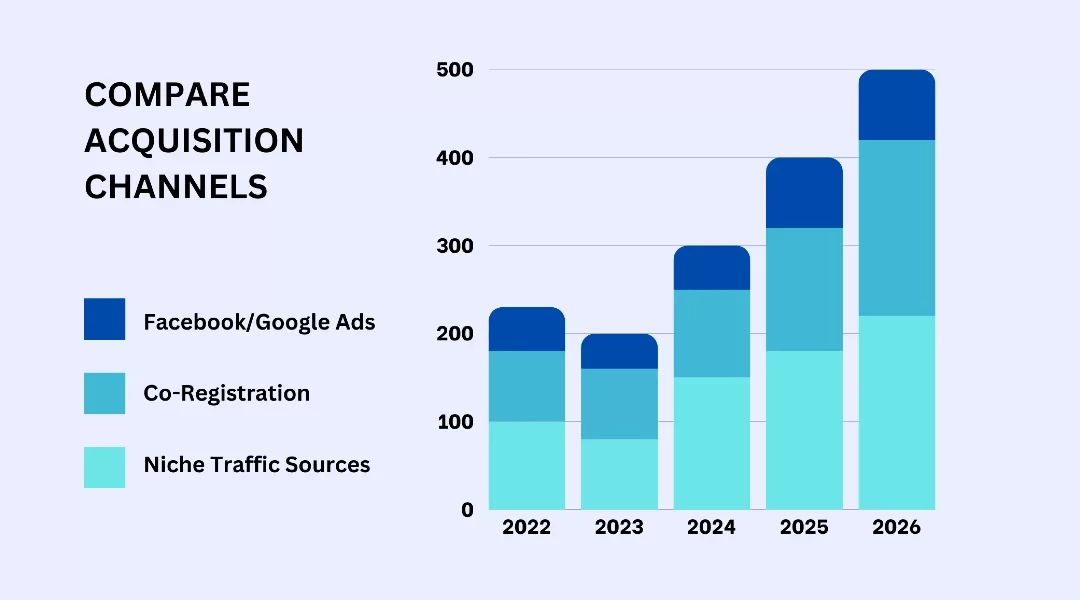
Customer acquisition costs continue to rise across digital channels, forcing businesses to find more efficient ways to reach qualified prospects. While most companies rely heavily on Facebook and Google Ads, three alternative performance marketing strategies can deliver lower cost per acquisition while maintaining lead quality: diversified traffic sources, co-registration lead generation, and inbound call marketing.
Table of Contents
- Why Traditional Customer Acquisition Isn’t Enough
- Strategy 1: Leverage Industry-Specific Traffic Sources
- Strategy 2: Tap Into Co-Registration Lead Generation
- Strategy 3: Shift from Outbound to Inbound Calls
- The Lead-to-Call Methodology
- Building a Diversified Acquisition Strategy
- Is Performance Marketing Right for Your Business?
- Frequently Asked Questions
Why Traditional Customer Acquisition Isn’t Enough
Without a consistent, cost-effective customer acquisition process, your business faces an ongoing challenge: how do you maintain growth when your primary channels become saturated or too expensive? Sustainable growth requires predictable lead flow across three critical areas: traffic generation, qualified lead capture, and sales conversations.
The businesses that thrive are those that diversify their acquisition channels beyond the obvious platforms. The following three strategies offer proven alternatives that complement your existing marketing while often delivering better unit economics.
Strategy 1: Leverage Industry-Specific Traffic Sources
Facebook and Google dominate digital advertising spend, but this dominance creates an opportunity. Niche traffic sources specific to your industry or customer context often have less competition and more qualified audiences.
These specialized platforms exist across nearly every vertical, from financial services to healthcare to home improvement. The advantage is immediate: your campaigns reach people already interested in your category, not general internet users who might be interested.
Performance-based pricing on these platforms means you only pay for actual results, whether that’s clicks, leads, or conversions. This reduces wasted spend and makes testing new channels less risky.
The real power comes from diversification itself. When you spread acquisition across multiple sources, you create portfolio effects. Some channels will perform above your target cost per acquisition, others below. The aggregate performance smooths out volatility and makes scaling more predictable. You’re no longer dependent on a single platform’s algorithm changes or competitive dynamics.
Strategy 2: Tap Into Co-Registration Lead Generation
Co-registration captures potential customers at a unique moment: when they’re already engaged with a complementary brand. As users register on partner websites, they see opt-in offers for related products and services. Those who express interest become your exclusive leads.
This creates a win-win scenario. Website owners generate additional revenue from their registration flows. Lead buyers gain access to consumers who are actively engaged and receptive to new offers, with significantly lower friction than cold outreach.
The economics often surprise businesses new to co-registration. Because these leads come from existing user experiences rather than paid advertising, costs per lead typically run well below other channels. For companies with efficient lead nurturing processes, whether email automation or outbound calling, co-registration can become a cornerstone acquisition channel.
Scalability is another major advantage. As you identify high-performing partner sites and optimize your offers, you can increase volume without proportionally increasing costs. The key is having the infrastructure to work leads quickly, as response time directly correlates with conversion rates in co-registration campaigns.
Strategy 3: Shift from Outbound to Inbound Calls
Cold calling has become increasingly ineffective as consumers screen unknown numbers and avoid unsolicited contact. The traditional outbound model wastes resources on low connection rates and frustrated prospects. There’s a better approach: make prospects want to call you.
Pay-per-call marketing flips the script entirely. Instead of your team chasing leads, qualified prospects initiate contact when they’re ready to learn more. Your sales team receives inbound calls from people who have already expressed interest, dramatically improving conversation quality and conversion rates.
These calls can originate from multiple channels, both online and offline. Search ads, display campaigns, direct mail, radio, and television can all drive phone traffic when structured properly. The key is working with partners who have the technology to track call sources, measure duration and quality, and optimize based on actual business outcomes.
Call duration typically serves as a quality metric, with longer conversations indicating genuine interest. Billing structures often reflect this, charging only for calls that meet minimum duration thresholds. This ensures you pay for qualified conversations, not wrong numbers or quick hang-ups.
The Lead-to-Call Methodology
Rex Direct’s Lead-to-Call process takes inbound call marketing a step further by adding qualification layers before leads ever reach your sales team. Rather than sending every captured lead directly to your call center, we filter and validate leads based on your specific criteria.
This pre-qualification makes your call center dramatically more efficient. Agents spend less time on unqualified prospects and more time with high-intent potential customers. Connection rates improve, talk time increases, and cost per conversion drops.
The difference between standard pay-per-call and the Lead-to-Call methodology is quality control. By screening leads before they become calls, we ensure your team’s time is spent on genuine opportunities, not filtering out poor matches.
Building a Diversified Acquisition Strategy
Improving customer acquisition is never a one-time fix. It requires ongoing testing, optimization, and a willingness to explore channels outside your comfort zone. The companies that consistently lower their customer acquisition costs while maintaining growth are those that refuse to become over-dependent on any single platform or tactic.
Each of these three strategies addresses a different aspect of the acquisition challenge. Industry-specific traffic sources put you in front of pre-qualified audiences. Co-registration captures interest at high-intent moments. Inbound call marketing ensures you speak with prospects who are ready for a conversation.
Together, they create a more resilient, scalable acquisition engine that isn’t vulnerable to the algorithm changes, competition increases, or platform policy shifts that plague single-channel strategies.
Is Performance Marketing Right for Your Business?
Not every customer acquisition strategy fits every business model. The right approach depends on your industry, average customer value, sales cycle length, and internal capabilities.
Rex Direct offers complimentary strategy evaluations to help businesses determine which performance marketing channels align with their goals. We assess your current acquisition costs, identify potential alternative channels, and design test campaigns that provide clear data on what works for your specific situation.
Frequently Asked Questions About Customer Acquisition Strategies
What is customer acquisition cost (CAC)?
Customer acquisition cost is the total expense required to acquire a new customer, calculated by dividing your total marketing and sales costs by the number of new customers gained. This metric is essential for understanding the efficiency of your marketing channels and overall business profitability.
How can I lower my customer acquisition cost?
Lower CAC by diversifying into less competitive channels, improving targeting precision, optimizing conversion rates, and focusing on high-intent prospects. Alternative channels like co-registration, industry-specific traffic sources, and pay-per-call often deliver lower costs than saturated platforms like Facebook and Google.
What are industry-specific traffic sources?
Industry-specific traffic sources are advertising platforms and publisher networks that cater to particular verticals like financial services, healthcare, or home improvement. These channels offer more qualified audiences and less competition than general platforms, often resulting in better cost per acquisition.
How does pay-per-call marketing work?
Pay-per-call marketing generates inbound phone calls from qualified prospects through various channels like search ads, display advertising, or offline media. You only pay when prospects call, and typically only for calls exceeding a minimum duration threshold, ensuring you pay for quality conversations with high-intent buyers.
What’s the difference between co-registration and buying leads?
Co-registration generates fresh, exclusive leads in real-time when consumers opt in during registration on partner sites. Purchased leads are typically older, shared among multiple buyers, and may lack proper consent. Co-reg leads are TCPA-compliant, exclusive to your brand, and generally convert at significantly higher rates.
Should I abandon Facebook and Google Ads?
No, don’t abandon these platforms entirely—diversify beyond them. Facebook and Google can still deliver results, but relying solely on them leaves you vulnerable to rising costs and algorithm changes. The most successful businesses use multiple channels to create a more stable, cost-effective acquisition portfolio.
What is the Lead-to-Call methodology?
Lead-to-Call is Rex Direct’s proprietary process that adds qualification layers before leads reach your call center. We filter and validate leads based on your criteria, ensuring your agents connect only with high-intent prospects. This increases efficiency, improves connection rates, and lowers cost per conversion.
How do I know which customer acquisition channel is right for my business?
The right channel depends on your industry, customer lifetime value, sales cycle, and internal capabilities. Businesses with high-volume capacity benefit from co-registration. Those with strong sales teams excel with pay-per-call. Companies in specific verticals should explore industry-specific traffic sources. Testing across multiple channels reveals what works best.
What’s a reasonable budget to test alternative acquisition channels?
Most effective tests require $3,000-$10,000 per channel to gather statistically significant data. This budget allows you to test multiple traffic sources, targeting variations, and creative approaches. Start with one channel, prove the model, then expand to others while maintaining your cost per acquisition targets.