
Understanding Cost Per Lead Benchmarks in the Solar Industry
In the solar industry, a realistic cost per lead (CPL) benchmark typically ranges from about $70 to $200 per qualified residential lead, depending on market, channel, and lead quality. With a well-structured performance-based marketing program, most solar companies can reach sustainable CPL targets within 60–120 days of optimization. The tradeoff is that pushing for the lowest possible CPL usually reduces lead quality and hurts close rates and ROI.
Solar installers, EPCs, and marketing managers are under pressure to generate consistent, high-intent leads without wasting budget on clicks that never convert. This article explains how to think about cost per lead benchmarks in the solar industry, why CPLs vary so much, and how performance-based marketing with a partner like Rex Direct can help you control cost while improving lead quality. The goal is to help you make a clear business decision about how to structure your lead generation, pay-per-call, and traffic acquisition strategy.
Table of Contents
- What Cost Per Lead Means in the Solar Industry
- Why Solar Cost Per Lead Benchmarks Vary So Widely
- Common Causes of High CPL and Poor Lead Quality
- What to Check First if Your Solar CPL Is Too High
- How to Improve Solar Lead Generation Performance
- When Performance Marketing Works Best for Solar
- When Performance Marketing May Not Work Well
- Leads vs Calls vs Traffic: What’s Best for Solar Companies?
- Cost, ROI, and Benchmark Ranges for Solar CPL and Calls
- Mistakes to Avoid in Solar Lead Generation
- Trust, Quality & Compliance in Solar Lead Generation
- Decision Guide: How to Choose the Right Solar Growth Strategy
- Frequently Asked Questions
- Summary & Next Steps
What Cost Per Lead Means in the Solar Industry
Cost per lead (CPL) is the amount you spend on marketing to generate a single lead that meets your agreed criteria. In solar, a “lead” is usually a homeowner or business that:
- Is within your service area
- Meets basic property criteria (roof type, ownership, shade, etc.)
- Has expressed interest in solar (form fill, call, or qualified inquiry)
For performance-based marketing, CPL is often tied to specific filters such as credit score ranges, utility bill minimums, or roof ownership. The tighter the filters, the higher the CPL, but usually the better the close rate and ROI.
Why Solar Cost Per Lead Benchmarks Vary So Widely
Solar CPL benchmarks are not one-size-fits-all. Two installers in different states can see very different costs for similar leads. Key drivers include:
- Market competition: Highly competitive states (CA, FL, TX, AZ, NJ, NY) typically have higher media costs and higher CPLs.
- Targeting and filters: Requiring high credit, specific utilities, or roof conditions increases cost but improves sales efficiency.
- Lead type: Inbound calls usually cost more than web form leads but convert at higher rates.
- Channel mix: Paid search, social, native, and comparison sites all have different cost structures and intent levels.
- Brand strength: Well-known brands often convert traffic more efficiently, lowering effective CPL.
Because of these variables, it is more useful to think in ranges and ROI rather than chasing a single “ideal” CPL number. A $350 lead that closes at 20% can be far more profitable than a $150 lead that closes at 5%.
Common Causes of High CPL and Poor Lead Quality
When solar companies complain about “high CPL” or “low quality leads,” the root causes usually fall into a few patterns:
- Misaligned targeting: Campaigns are reaching renters, out-of-area prospects, or low-credit consumers who cannot qualify.
- Weak or confusing offers: Generic ads (“Go Solar Now”) without clear value propositions lead to low click-through and conversion rates.
- Slow or inconsistent follow-up: Leads are not contacted quickly, so intent drops and close rates fall.
- Overly broad lead definitions: Counting every form fill as a lead, even if it is incomplete or unqualified.
- Cheap, shared, or incentivized leads: Buying the lowest-cost leads from low-quality sources that prioritize volume over intent.
These issues inflate your effective CPL and depress ROI, even if the “headline” CPL looks low on paper.
What to Check First if Your Solar CPL Is Too High
Before changing providers or cutting budget, there are a few quick diagnostic checks that can reveal easy wins:
- Lead definition: Confirm exactly what counts as a billable lead and whether it matches your sales team’s needs.
- Speed to contact: Measure how quickly your team calls new leads; aim for under 5 minutes whenever possible.
- Contact rates: Track what percentage of leads you actually reach by phone or email.
- Qualification questions: Review your forms or call scripts to ensure you are capturing key filters (homeownership, roof, bill amount).
- Source-level performance: Break down CPL and close rate by channel, campaign, and publisher, not just overall.
Often, improving follow-up speed, tightening qualification, and reallocating budget from weak sources to strong ones can reduce effective CPL without changing your overall spend.
How to Improve Solar Lead Generation Performance
Improving performance in solar lead generation is about aligning cost, quality, and sales process. A performance-based partner like Rex Direct focuses on:
Clarify Your Ideal Solar Customer Profile
- Define target geographies, property types, and utility territories.
- Set minimum utility bill thresholds (for example, $100+ per month).
- Decide on credit or financing requirements if applicable.
The clearer your criteria, the easier it is to build campaigns that generate qualified, high-intent leads.
Use Performance-Based Channels Strategically
Instead of paying for impressions or clicks, performance-based marketing focuses on:
- Pay-per-lead: You pay only for leads that meet agreed filters.
- Pay-per-call: You pay for qualified inbound calls that meet duration and qualification rules.
- Performance traffic: You pay based on outcomes (leads or calls) generated from traffic sources.
This structure aligns incentives: your partner is motivated to deliver leads that convert, not just traffic.
Optimize Lead Quality, Not Just Volume
High-volume, low-quality leads drain your sales team and inflate your cost per sale. Better results come from:
- Using pre-qualification questions to filter out ineligible prospects.
- Testing different landing pages and offers to attract serious buyers.
- Prioritizing exclusive or semi-exclusive leads over heavily shared lists.
For a deeper look at what makes a lead “qualified,” see the discussion of qualified leads and how to identify them at Qualified Leads: What They Are, How to Identify Them, and How to Generate More.
Align Marketing With Your Sales Process
- Ensure your sales team is trained on how leads are generated and what the prospect has seen.
- Use consistent messaging from ad to landing page to phone script.
- Implement simple lead routing and CRM tracking to avoid dropped opportunities.
When marketing and sales are aligned, your close rates improve, which makes higher-quality leads more profitable even at a higher CPL.
When Performance Marketing Works Best for Solar
Performance-based marketing is particularly effective for solar companies that:
- Have a defined service area and clear customer profile.
- Can respond quickly to new leads and calls.
- Track close rates and revenue by lead source.
- Are ready to scale once profitable benchmarks are proven.
In these situations, a partner like Rex Direct can test multiple channels, optimize toward your best-performing segments, and scale volume while keeping CPL and cost per sale within your targets.
When Performance Marketing May Not Work Well
There are also scenarios where performance marketing may be less effective or harder to scale:
- Very small or new markets: Limited consumer demand can cap lead volume regardless of budget.
- Unclear or changing offers: If your pricing, incentives, or financing options change frequently, campaigns may underperform.
- Weak sales process: If leads are not contacted quickly or consistently, even high-quality leads will not convert well.
- Overly restrictive filters: Extremely narrow criteria can make leads prohibitively expensive or impossible to source at scale.
Being transparent about these limitations helps set realistic expectations and ensures you invest where performance marketing can actually deliver results.
Leads vs Calls vs Traffic: What’s Best for Solar Companies?
Solar companies often have to choose between buying leads, paying for inbound calls, or driving raw traffic to their own funnels. Each option has tradeoffs.
Pay-Per-Lead for Solar
With pay-per-lead, you pay for each qualified inquiry that meets your agreed filters. This works well when:
- You have a strong inside sales team that can call and nurture leads.
- You want predictable volume and cost per lead.
- You need flexibility to adjust filters and geos over time.
The downside is that form leads may have lower immediate intent than live calls, so follow-up speed and process are critical.
Pay-Per-Call (Inbound Only)
With pay-per-call, you pay for qualified inbound calls that meet duration and qualification rules. This is ideal when:
- You have a call center or sales reps ready to take calls in real time.
- You want to speak with prospects at the peak of their interest.
- You value higher close rates, even at a higher cost per opportunity.
Pay-per-call typically has a higher unit cost than web leads but can deliver better ROI due to stronger intent and faster conversations.
Performance Traffic to Your Own Funnels
In this model, you or your agency manage the landing pages and conversion funnels, while a partner like Rex Direct drives targeted traffic on a performance basis. This can work well if:
- You have proven landing pages and conversion flows.
- You want more control over branding and user experience.
- You are prepared to optimize your own conversion rates.
The tradeoff is that you take on more responsibility for conversion, so your internal marketing capabilities matter more.
Cost, ROI, and Benchmark Ranges for Solar CPL and Calls
Understanding realistic cost and ROI expectations is essential for planning and budgeting. While exact numbers vary by market and partner, the following ranges are common in the residential solar space:
Typical Cost Per Lead Benchmarks
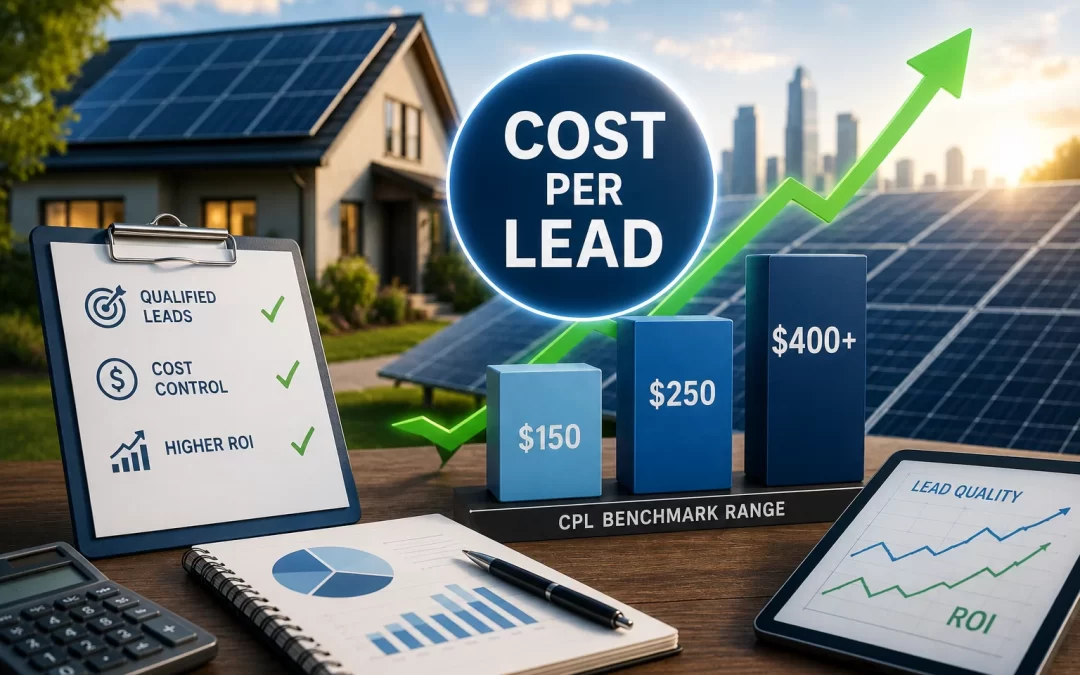
- Residential solar web leads: Approximately $150–$400 per qualified lead, depending on geo, filters, and competition.
Factors that push CPL higher include strict credit requirements, narrow geographies, and exclusive lead arrangements. Factors that can lower CPL include broader targeting, shared leads, or less stringent qualification criteria.
Typical Cost Per Call Benchmarks
- Inbound solar calls: Often $100–$400+ per qualified call, depending on filters and call duration requirements.
Because calls typically convert at higher rates than form leads, a higher cost per call can still produce a lower cost per sale.
Conversion Rate Benchmarks
- Lead-to-appointment rate: Many solar companies see 12%–35% of qualified leads turn into set appointments when follow-up is fast.
- Appointment-to-sale rate: Commonly 20–35%, depending on sales skill, pricing, and competition.
- Lead-to-sale rate: Often in the 5–15% range for well-managed programs.
These are broad benchmarks, not guarantees. Your actual performance will depend on your sales process, market, and offer.
How CPL, Quality, and ROI Interact
It is important to evaluate CPL in the context of revenue and profit:
- A higher CPL with strong close rates can produce a lower cost per sale and higher profit.
- Very cheap leads often have poor contact and close rates, raising your true cost per sale.
- Scaling volume can increase or decrease efficiency depending on how well you manage new sources and maintain quality controls.
Rex Direct focuses on this full-funnel view, not just the headline CPL, to help solar companies grow profitably rather than just cheaply.
Mistakes to Avoid in Solar Lead Generation
Avoiding a few common mistakes can save significant budget and frustration:
- Chasing the lowest CPL: Prioritizing price over quality usually leads to low-intent, shared, or incentivized leads that rarely close.
- Not defining “qualified” clearly: Vague criteria lead to misaligned expectations between you and your providers.
- Ignoring compliance: Overlooking consent and TCPA requirements can create serious legal and reputational risk.
- Underinvesting in follow-up: Treating leads as “one-call close” opportunities instead of nurturing them over time.
- Not tracking by source: Failing to measure performance at the campaign or publisher level makes optimization impossible.
Working with an experienced performance partner helps you avoid these pitfalls and build a more predictable acquisition engine.
Trust, Quality & Compliance in Solar Lead Generation
Trust and compliance are critical in solar, where consumers are making high-value, long-term decisions. A responsible performance partner should prioritize:
Lead Quality vs Quantity
- Focusing on leads that meet your agreed filters and show real interest.
- Using validation tools to check contact information and basic eligibility.
- Regularly reviewing disposition data (contacted, qualified, not interested) to refine targeting.
Quality-focused programs may deliver fewer leads than “cheap list” providers, but they typically produce more installs and better ROI.
Exclusive vs Shared Leads
Exclusive leads are sold to one buyer, while shared leads are sold to multiple installers. Each has pros and cons:
- Exclusive leads: Higher cost, less competition, better customer experience.
- Shared leads: Lower cost, more competition, require faster and more aggressive follow-up.
Many solar companies prefer a mix, using exclusive leads for core markets and shared leads to supplement volume where their sales process is strong.
Fraud Risks and Traffic Quality
Solar lead generation can attract bad actors who generate fake or low-quality leads. To mitigate this, a reputable partner should:
- Use fraud detection and validation tools to screen out obvious fakes.
- Monitor publisher performance and cut off poor-quality sources quickly.
- Offer transparent reporting so you can see where leads are coming from.
This protects your budget and your brand while keeping your sales team focused on real opportunities.
TCPA and Consent Considerations
Solar companies must comply with regulations like the Telephone Consumer Protection Act (TCPA) when calling or texting leads. While this is not legal advice, best practices include:
- Ensuring leads have provided clear, documented consent to be contacted.
- Maintaining records of consent and lead source.
- Working with partners who understand and respect compliance requirements.
Rex Direct builds consent and transparency into its lead generation processes to help protect clients and consumers alike.
Decision Guide: How to Choose the Right Solar Growth Strategy
Choosing between leads, calls, and traffic—and between in-house and outsourced marketing—comes down to your capabilities and goals.
Should You Use Lead Generation, Pay-Per-Call, or Traffic?
- Choose pay-per-lead if you have a strong inside sales team and want predictable volume at a set CPL.
- Choose pay-per-call if you have agents ready to take calls and want higher-intent opportunities, even at a higher unit cost.
- Choose performance traffic if you have proven funnels and want more control over branding and user experience.
Many successful solar companies use a blended approach, testing each model and scaling what delivers the best cost per sale.
In-House vs Outsourced Performance Marketing
Running everything in-house gives you control but requires expertise in media buying, compliance, and optimization. Outsourcing to a performance partner like Rex Direct offers:
- Access to multiple traffic sources and publishers without managing each one directly.
- Performance-based pricing that aligns cost with outcomes.
- Experience with benchmarks, filters, and compliance in the solar space.
For many solar companies, the most effective model is a hybrid: maintain internal marketing for brand and local efforts, while using a performance partner to drive scalable, measurable lead flow.
When Is Performance Marketing Worth It?
Performance marketing is usually worth it when:
- You know your target CPL and cost per sale thresholds.
- You have the capacity to handle more leads or calls.
- You are willing to test, measure, and adjust over a 60–120 day period.
If you are not yet clear on your economics or sales process, it may be wise to refine those first, then engage a performance partner to scale what works.
Frequently Asked Questions
What is a good cost per lead for residential solar?
For residential solar, many companies see qualified CPLs in the $70–$200 range, depending on market and filters. A “good” CPL is one that allows you to acquire customers profitably after factoring in your close rate and average system value.
Why are some solar leads so cheap compared to others?
Very cheap solar leads are often shared, lightly qualified, or generated through low-intent tactics such as broad sweepstakes or incentives. While the headline CPL looks attractive, these leads usually have low contact and close rates, which drives up your true cost per sale.
How long does it take to optimize a solar lead generation program?
Most solar companies need 60–120 days to properly test, optimize, and scale a new performance-based program. This allows enough time to gather data by source, adjust filters, refine follow-up, and reach stable, repeatable benchmarks.
Should I focus on more leads or better-quality leads?
For most solar businesses, better-quality leads are more valuable than raw volume. Higher-intent, well-qualified leads may cost more per lead but typically deliver higher close rates and lower cost per sale, which is what ultimately matters for ROI.
How can I tell if my solar marketing partner is performing well?
Look beyond CPL and evaluate cost per sale, close rates, and revenue by source. A strong partner will provide transparent reporting, collaborate on qualification criteria, and be willing to adjust campaigns based on your real-world sales feedback.
Is pay-per-call better than pay-per-lead for solar?
Pay-per-call often delivers higher-intent opportunities and better close rates, but at a higher unit cost than web leads. The best choice depends on your sales structure; many solar companies use both, prioritizing calls where they have live agents available and leads where they have strong inside sales follow-up.
Summary & Next Steps
Cost per lead benchmarks in the solar industry vary widely, but most residential installers can expect qualified CPLs in the $150–$400 range and higher costs for call-based programs. The key is to evaluate CPL in the context of lead quality, close rates, and overall cost per sale, rather than chasing the lowest price per lead.
By clarifying your ideal customer, aligning marketing with your sales process, and working with a performance-based partner like Rex Direct, you can build a more predictable, scalable acquisition engine. The next step is to review your current CPL, close rates, and lead sources, then identify where performance-based leads, calls, or traffic can improve your ROI and support your growth goals.
If you are ready to tighten your benchmarks, reduce wasted spend, and focus on high-intent solar prospects, now is the time to evaluate your existing programs and explore a structured performance marketing approach. A well-designed partnership can help you move from inconsistent, high-cost leads to a sustainable pipeline of qualified opportunities that support long-term business growth.