
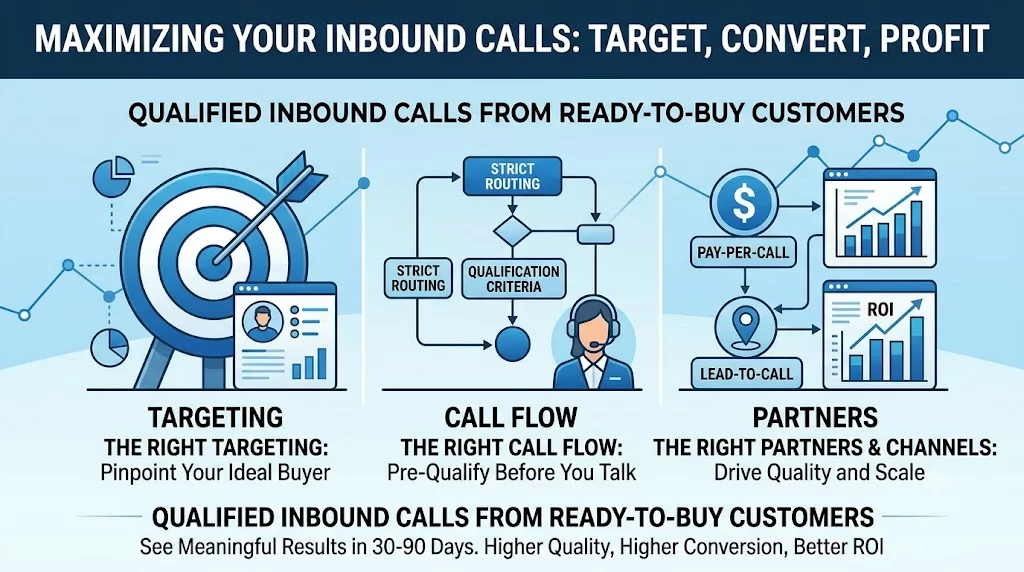
To get qualified inbound calls from customers ready to buy, you need three things working together: the right targeting, the right call flow, and the right performance-based partners or channels. That usually means using pay-per-call or lead-to-call campaigns, strict call routing rules, and clear qualification criteria before your team ever picks up the phone. Most businesses see meaningful results within 30–90 days once tracking, scripting, and optimization are in place, but costs and volume depend heavily on your industry and competition. The tradeoff is that higher-quality inbound calls usually cost more per call, but they convert at a much higher rate and deliver better ROI.
Many businesses struggle with low-quality leads, wasted ad spend, and sales teams tied up on calls that never convert. If you are a business owner, marketing manager, or agency leader, the goal is not “more calls” but “more profitable calls.” This article explains how to structure your marketing so that the calls coming in are from people who are ready to buy, and how performance-based marketing models like pay-per-call and lead-to-call can help you get there.
Table of Contents
- What “Qualified Inbound Calls from Ready-to-Buy Customers” Really Means
- Why You’re Not Getting Enough Qualified Calls
- Common Causes of Poor Call Performance and Low ROI
- What to Check First: Quick Wins and Diagnostics
- How to Improve Qualified Inbound Call Results
- When Performance-Based Call Marketing Works Best
- When It May Not Work Well
- Leads vs. Calls vs. Traffic: Which Is Best for You?
- Cost, ROI, and Realistic Benchmarks for Qualified Calls
- Trust, Quality, and Compliance: Protecting Your Brand and Budget
- Mistakes to Avoid When Buying or Generating Calls
- How to Decide Your Best Approach and Next Step
- Frequently Asked Questions
- Summary and Next Steps
What “Qualified Inbound Calls from Ready-to-Buy Customers” Really Means
Qualified inbound calls are phone calls from prospects who:
- Match your target customer profile (location, budget, need, timing).
- Have a clear problem your product or service can solve.
- Are actively looking to buy or make a decision soon.
- Reach you by choice (they called you), not from cold outreach.
“Ready to buy” does not always mean they purchase on the first call, but it does mean:
- They are in the decision phase, not just browsing.
- They are open to a quote, consultation, or immediate booking.
- Your sales team can move them forward in one conversation.
To consistently get these calls, you need a system that filters out low-intent traffic and routes only serious prospects to your phone lines. That is where performance-based models like pay-per-call and structured lead-to-call processes become powerful.
Why You’re Not Getting Enough Qualified Calls
Most businesses do not have a “call problem”; they have a “funnel and targeting problem.” The wrong people are seeing your ads, or the right people are not being guided to call you at the right moment.
Common reasons this happens:
- Broad or unfocused targeting: Ads and campaigns reach people who are curious, not committed.
- Weak or generic messaging: Your offer does not clearly speak to urgent, high-intent buyers.
- No clear call-to-call path: Landing pages and ads do not make it obvious that calling is the best next step.
- Operational gaps: Missed calls, long hold times, or limited hours turn good prospects away.
- No performance accountability: You pay for impressions or clicks, not for actual qualified conversations.
When these issues stack up, you end up with low lead volume, low-quality calls, or both. The result is frustrated sales teams and rising acquisition costs.
Common Causes of Poor Call Performance and Low ROI
Even if you are already getting inbound calls, they may not be profitable. Poor performance usually shows up as:
- High cost per call but low close rates.
- Sales reps spending time on unqualified or irrelevant callers.
- Inconsistent call volume that makes staffing difficult.
Typical root causes include:
- Misaligned keywords or channels: For example, targeting “free” or “cheap” terms when you sell premium services.
- No pre-qualification: Anyone can call, even if they are outside your service area or budget.
- Shared or recycled leads: Prospects are being contacted by multiple competitors, so intent and trust drop.
- Weak tracking: You cannot see which campaigns or partners are driving profitable calls.
- Sales process issues: No script, no clear offer, or slow follow-up on missed calls and voicemails.
Fixing these issues is often more impactful than simply “buying more calls.”
What to Check First: Quick Wins and Diagnostics
Before investing more budget, run a quick diagnostic on your current call flow and marketing.
1. Check Your Call Handling Basics
- Are calls answered live during business hours?
- Is there a backup plan (overflow, call center, voicemail with rapid callback)?
- Do you track missed calls and return them quickly?
Even the best marketing cannot fix missed or poorly handled calls.
2. Review Your Targeting and Messaging
- Are you clear about who you want to call (location, income, problem, urgency)?
- Does your ad copy speak directly to urgent needs and next steps (“Call now for a same-day appointment”)?
- Is your phone number prominent on landing pages and ads?
3. Audit Your Tracking
- Do you use unique tracking numbers for different campaigns or partners?
- Can you see which calls turn into sales or booked appointments?
- Are you recording calls (where allowed) for quality and training?
Without this visibility, you cannot optimize or hold partners accountable.
How to Improve Qualified Inbound Call Results
Improving results is about tightening the entire chain: targeting, traffic, call routing, and sales process. Performance-based models like pay-per-call and lead-to-call are designed for this.
1. Use Performance-Based Call Models
Instead of paying for clicks or impressions, you pay for actual inbound calls or qualified leads that can be converted into calls.
- Pay-per-call: You pay only when a call meeting your criteria (duration, source, time of day) is delivered.
- Lead-to-call: Online leads are automatically dialed and connected to your team as live calls.
For a deeper breakdown of how this works, including costs and conversion strategy, see the detailed pay-per-call advertising guide: costs, lead quality, and conversion strategy.
2. Define Clear Qualification Criteria
To get “ready-to-buy” callers, you must define what “qualified” means for your business:
- Serviceable geography (zip codes, states, radius).
- Minimum budget or deal size.
- Type of problem or product interest.
- Timing (needs help now vs. six months from now).
These criteria should be built into your campaigns and call routing rules so unqualified calls are filtered out early.
3. Align Offers and Landing Pages to Phone Calls
Make calling the obvious next step for high-intent visitors:
- Use strong, specific CTAs: “Call now for a free quote in 5 minutes” or “Speak to a licensed agent today.”
- Show phone numbers prominently, including click-to-call on mobile.
- Reassure visitors about what will happen on the call (no spam, no long hold times, clear value).
4. Optimize Call Routing and Availability
- Route calls to the right team (sales vs. support) based on campaign or IVR options.
- Extend coverage hours if your audience calls outside 9–5.
- Use overflow or backup agents during peak times to avoid long waits.
5. Improve Sales Scripts and Training
Even highly qualified callers can be lost with a weak first impression. Ensure your team:
- Answers with a professional, consistent greeting.
- Quickly confirms the caller’s need and urgency.
- Guides the conversation toward a clear next step: booking, payment, or signed agreement.
6. Work with Specialized Performance Partners
Building your own high-intent traffic and call funnel can be complex and time-consuming. Many businesses partner with specialized pay-per-call networks or performance agencies that already have:
- Proven traffic sources and optimization processes.
- Fraud detection and call quality controls.
- Experience in your vertical (insurance, home services, legal, financial services, etc.).
To understand how networks compare to running everything yourself, review the analysis in pay-per-call networks vs. in-house call campaigns.
When Performance-Based Call Marketing Works Best
Performance-based models like pay-per-call and lead-to-call work especially well when:
- Your product or service has a clear, urgent need (e.g., repairs, insurance, legal help, medical services, financial relief).
- Your average customer value (LTV) supports a meaningful cost per call.
- You have a sales team or call center ready to handle volume and close deals.
- You can define clear qualification criteria and success metrics.
In these cases, paying only for qualified calls or leads can be more predictable and scalable than managing multiple ad platforms yourself.
When It May Not Work Well
Performance-based call marketing may be less effective when:
- Your offering is low-ticket with very thin margins.
- Your sales process is long, complex, or requires multiple stakeholders over months.
- You cannot handle variable call volume or do not have a dedicated sales team.
- Your target audience rarely uses the phone and prefers self-service online.
In these scenarios, lead nurturing, email, or self-serve funnels may be more cost-effective than focusing on inbound calls.
Leads vs. Calls vs. Traffic: Which Is Best for You?
There are three main performance-based options: buying leads, buying calls, or buying traffic.
1. Pay-Per-Lead
You pay for contact details (name, phone, email, sometimes more data) of people who have expressed interest.
- Pros: Usually cheaper per unit than calls; can be nurtured over time; flexible follow-up.
- Cons: Requires strong follow-up systems; leads may be shared; lower immediate intent than live calls.
2. Pay-Per-Call
You pay only when a live call meeting your criteria is connected to your team.
- Pros: Higher intent; faster path to revenue; easier for sales teams to convert.
- Cons: Higher cost per unit; requires good call handling; not every call will close.
For a direct comparison of conversion potential, see the breakdown in pay-per-call vs. pay-per-lead: which one converts better.
3. Pay-Per-Click / Traffic
You pay for visitors to your website or landing pages, usually via search or social ads.
- Pros: Full control over funnel; can build brand and retargeting audiences; scalable.
- Cons: You carry all the risk; requires expertise in ad platforms, CRO, and tracking; not guaranteed to produce calls.
Many businesses use a mix: traffic to build awareness, leads for nurturing, and calls for high-intent buyers ready to talk now.
Cost, ROI, and Realistic Benchmarks for Qualified Calls
Costs vary widely by industry, competition, and geography, but there are useful ranges and benchmarks to guide expectations.
Typical Cost Ranges
- Cost per lead (CPL): Often ranges from $10–$40 in less competitive verticals (e.g., basic home services) to $50–$200+ in high-value sectors (e.g., legal, insurance, financial services).
- Cost per call (CPCall): Qualified inbound calls can range from $20–$60 in simpler markets to $100–$300+ in highly competitive, high-LTV industries.
- Cost per click (CPC): Search and social clicks may range from $1–$10+ depending on keywords and audience.
These are broad ranges, not guarantees, but they illustrate why you must look beyond “cheap” and focus on profitability.
Conversion Rate Benchmarks
- Lead-to-opportunity: 10–30% of leads may become real sales opportunities with good follow-up.
- Call-to-sale: 15–40% of qualified inbound calls can convert to sales or booked appointments in many service industries.
- Click-to-call or click-to-lead: 5–20% of visitors may convert to a call or lead on a well-optimized landing page.
Your actual numbers will depend on your offer, pricing, and sales process, but these benchmarks help you model ROI.
What Affects Cost and ROI
- Industry and competition: More competition for the same customer drives up costs.
- Targeting precision: Narrow, well-defined audiences often cost more per unit but waste less budget.
- Lead and call quality: Higher-quality calls cost more but convert at a higher rate, improving ROI.
- Sales effectiveness: Strong scripts and trained reps can double or triple your conversion rate from the same calls.
- Scaling: As you scale, costs may rise due to reaching less efficient channels, but process improvements can offset this.
Why Cheap Leads and Calls Can Hurt Profitability
Low-cost leads or calls often come with hidden tradeoffs:
- Lower intent (freebie seekers, researchers, or wrong-fit prospects).
- Higher rates of invalid or fraudulent activity.
- More time wasted by your sales team qualifying and disqualifying.
It is usually better to pay more per call or lead if your close rate and average order value support it. The key metric is cost per acquisition (CPA) and overall return on ad spend (ROAS), not just the cheapest unit price.
Trust, Quality, and Compliance: Protecting Your Brand and Budget
When buying leads, calls, or traffic, quality and compliance are as important as volume. Poor-quality or non-compliant activity can damage your brand and create legal risk.
Lead Quality vs. Quantity
High lead volume looks good on paper but can overwhelm your team and lower morale if most contacts are unqualified. Focus on:
- Exclusive or semi-exclusive leads where possible.
- Clear qualification questions on forms and IVR menus.
- Regular feedback loops with partners on which calls and leads are closing.
Exclusive vs. Shared Leads
- Exclusive leads: Only your business receives the lead. Higher cost, higher close rate, less competition.
- Shared leads: Multiple businesses receive the same lead. Lower cost, but you compete on speed and sales skill.
For inbound calls, exclusivity is often built in (one caller, one conversation), but you should still clarify how calls are generated and routed.
Fraud Risks and Bad Traffic
Risks include:
- Fake or incentivized leads with no real intent.
- Bot traffic or click fraud on pay-per-click campaigns.
- Call farms generating low-quality or short-duration calls.
Mitigation steps:
- Use call tracking and recording to verify quality.
- Set minimum call duration thresholds for billable calls.
- Work with partners who have fraud detection and transparent reporting.
TCPA and Consent Considerations
If you are calling leads or using lead-to-call systems, you must ensure proper consent under regulations like the Telephone Consumer Protection Act (TCPA) in the U.S. At a high level, this means:
- Clear disclosure that the consumer agrees to be contacted by phone or text.
- Documented proof of consent (time, source, and language of the form or opt-in).
- Respecting opt-outs and do-not-call requests.
Consult your legal counsel for specific requirements in your jurisdiction, and work only with partners who take compliance seriously.
Mistakes to Avoid When Buying or Generating Calls
Avoid these common pitfalls that lead to wasted budget and poor results:
- Chasing the lowest price per call or lead: This almost always sacrifices quality and ROI.
- No clear definition of a “qualified” call: If you cannot define it, your partners cannot deliver it.
- Ignoring call handling and sales process: Great marketing cannot fix a weak close.
- Not tracking outcomes: If you do not know which calls turned into revenue, you cannot optimize.
- Scaling too fast without controls: Rapid volume increases can expose quality or compliance issues.
- Relying on one channel or partner: Diversification reduces risk and improves stability.
How to Decide Your Best Approach and Next Step
Choosing between leads, calls, and traffic—and between in-house vs. outsourced—comes down to your goals, resources, and risk tolerance.
Should You Focus on Leads, Calls, or Traffic?
- Choose pay-per-call if your sales team converts well on the phone, your deals are high-value, and you want faster revenue from high-intent prospects.
- Choose pay-per-lead if you have strong follow-up systems (CRM, email, SMS) and can nurture prospects over time.
- Choose traffic (PPC, SEO) if you want full control of the funnel and are willing to invest in in-house expertise or agency support.
- Use a hybrid approach if you want both immediate revenue (calls) and a longer-term pipeline (leads and traffic).
In-House vs. Outsourced Performance Marketing
Handle more in-house if:
- You have an experienced marketing team and technical resources.
- You want full control over every step of the funnel.
- You are prepared for a longer ramp-up and testing period.
Work with specialized partners if:
- You want to pay only for performance (calls, leads) instead of building everything from scratch.
- You lack the time or expertise to manage multiple ad platforms and compliance requirements.
- You want faster access to proven traffic sources and call flows.
When Performance Marketing Is Worth It
Performance-based marketing is usually worth it when:
- Your customer lifetime value comfortably exceeds your target acquisition cost.
- You can handle and convert the volume of calls or leads you are buying.
- You have or can build the tracking needed to measure true ROI.
The best next step is to define your ideal customer, your acceptable cost per acquisition, and your capacity to handle calls. From there, you can test a focused performance-based campaign and scale what works.
Frequently Asked Questions
How long does it take to start getting qualified inbound calls?
Most businesses can start receiving qualified inbound calls within 2–4 weeks once tracking, call routing, and campaigns are set up. It typically takes 30–90 days of data to optimize targeting, scripts, and partner performance for consistent, scalable results.
What is a good cost per call for my business?
A “good” cost per call is one that allows you to acquire customers profitably based on your close rate and average customer value. For many service businesses, paying $50–$150 per qualified call can be attractive if 20–30% of those calls convert into customers with strong margins.
Why are my inbound calls not converting into sales?
Low conversion from calls is often due to weak qualification, poor call handling, or misaligned expectations set by ads and landing pages. Reviewing call recordings, tightening your script, and aligning your offer with the actual needs of callers usually leads to significant improvements.
Is pay-per-call better than pay-per-lead?
Pay-per-call often delivers higher-intent prospects and faster revenue because you speak to people in real time. However, it is usually more expensive per unit than leads, so it works best when your sales team is strong on the phone and your customer value supports the higher cost.
How do I avoid fake or low-quality leads and calls?
Use reputable partners, clear qualification criteria, and robust tracking (including call recordings and duration filters). Regularly review performance data, reject clearly invalid activity based on agreed rules, and prioritize partners who are transparent about their traffic sources and compliance practices.
Can I scale qualified inbound calls without losing quality?
You can scale while maintaining quality if you add volume gradually, monitor performance closely, and diversify your traffic sources and partners. Expect some increase in cost as you scale, but strong quality controls and continuous optimization can keep ROI healthy.
Summary and Next Steps
Getting qualified inbound calls from customers ready to buy is not about luck or volume; it is about building a controlled, performance-based system. By defining clear qualification criteria, improving your call handling, and using models like pay-per-call or lead-to-call, you can focus your budget on conversations that are most likely to turn into revenue.
For your business, the next step is to assess your current call performance, clarify your target customer and acceptable acquisition costs, and decide whether to build in-house capabilities or partner with a specialist. With the right structure and accountability in place, inbound calls can become one of the most predictable and profitable parts of your customer acquisition strategy.
If your current marketing is producing low-quality leads, inconsistent call volume, or rising costs, now is the time to reevaluate your approach. Start by tightening your tracking and qualification, then explore performance-based solutions that align cost with actual results so your team spends more time talking to people who are truly ready to buy.