Most marketing debates circle back to the same fundamental question: do you build for now, or build for later?
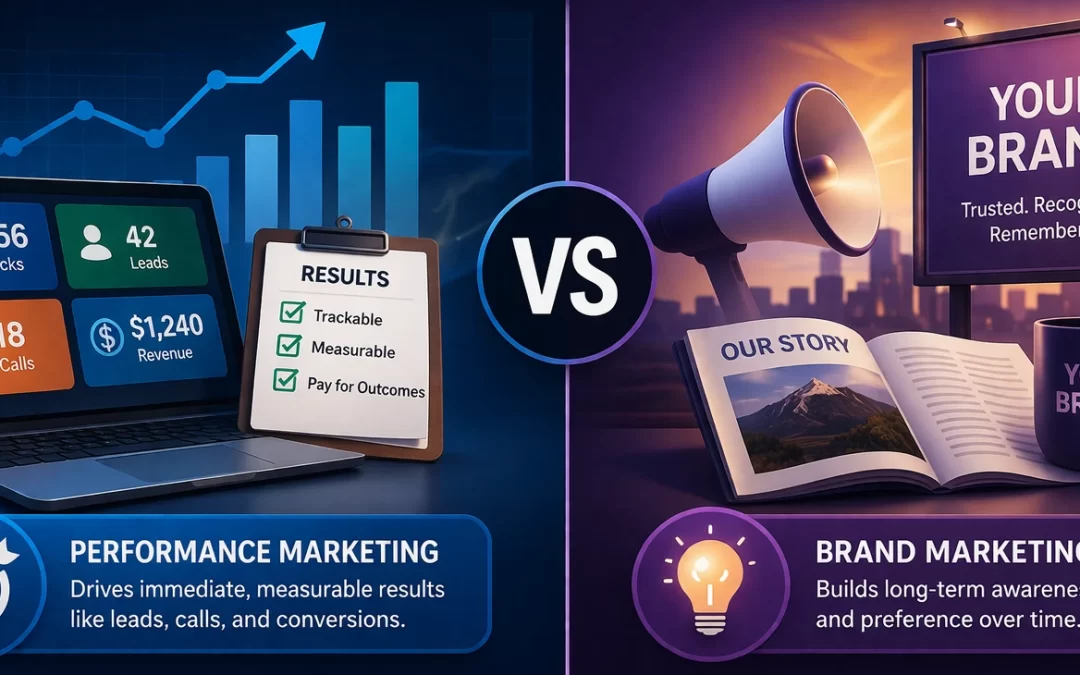
Performance marketing and brand marketing land on opposite sides of that question. One is about generating results you can track — leads, calls, conversions tied to real spend. The other is about shaping how people perceive your company over months and years.
There’s a place for both. The problem is that choosing the wrong one at the wrong time doesn’t announce itself — it just quietly drains your budget, stalls growth, or leaves you with a pipeline that looks healthy until your sales team tries to work it.
What follows is a plain-language breakdown of what each approach actually means, how they differ in practice, and how to figure out which one your business should be leaning on right now.
What Is Performance Marketing?
Performance marketing is exactly what it sounds like: you pay for performance. Clicks, leads, calls, form fills, purchases — outcomes you can track, attribute, and measure against what you spent.
What sets it apart is accountability. Every dollar connects to a specific action. If that action doesn’t happen, you don’t pay — or at the very least, you know precisely what you spent and what came back from it.
How Performance Marketing Works in Practice
A company running performance campaigns might partner with a lead generation service to receive inbound calls from people actively searching for their product. Some run paid search. Others purchase exclusive leads — verified, qualified contacts delivered in real time — where they only pay when those leads meet specific targeting criteria they’ve set in advance.
Performance marketing infrastructure typically includes:
- Defined targeting parameters — geography, demographics, intent signals, product interest
- Real-time delivery — leads or calls routed directly into CRM or call center systems
- Validation and compliance — ensuring contacts are legitimate and meet agreed standards
- Clear cost-per-outcome metrics — CPL (cost per lead), CPA (cost per acquisition), ROAS (return on ad spend)
Rex Direct operates within this model. Brands tell us who they’re trying to reach, and we handle the sourcing, validation, and delivery of qualified leads, inbound calls, or targeted traffic. You pay for results that meet your criteria — nothing else.
What Performance Marketing Does Best
- Generates pipeline on predictable timelines
- Scales acquisition when you have a proven offer and a clear conversion path
- Tests new markets or audiences with limited downside
- Holds spend accountable to real business outcomes
What Is Brand Marketing?
Brand marketing builds recognition, trust, and preference over time. Rather than driving immediate action, it shapes how your audience perceives you — so when they’re ready to buy, you’re already the obvious choice.
Think TV commercials, sponsorships, content series, social presence, PR, and brand campaigns. The goal isn’t a click. It’s a feeling, a memory, a reputation.
How Brand Marketing Works in Practice
Brand marketing investments tend to be broader and harder to attribute directly to revenue. A company running brand campaigns might:
- Sponsor an industry podcast to stay top of mind with a specific professional audience
- Run awareness-focused display ads across relevant publications
- Invest in long-form content that builds authority in their category
- Create video campaigns that tell the company’s story rather than promote a specific offer
The metrics differ: reach, impressions, brand recall, share of voice, sentiment, and — over longer periods — organic search growth and direct traffic increases.
What Brand Marketing Does Best
- Builds long-term competitive advantages
- Reduces customer acquisition costs over time as trust compounds
- Supports premium pricing by differentiating on perception
- Creates demand rather than just capturing it
The Core Differences at a Glance
| Performance Marketing | Brand Marketing | |
|---|---|---|
| Primary goal | Drive measurable actions | Build awareness and trust |
| Timeline | Short to medium term | Medium to long term |
| Attribution | High — direct and trackable | Low — indirect and diffuse |
| Payment model | Pay per result (lead, call, click) | Pay for exposure (impressions, reach) |
| Risk profile | Lower — spend tied to outcomes | Higher — results are uncertain and delayed |
| Best for | Pipeline generation, scaling | Category authority, brand equity |
| Key metrics | CPL, CPA, ROAS, conversion rate | Reach, recall, sentiment, share of voice |
The False Choice Most Marketers Make
Here’s where many companies stumble: they treat this as an either/or decision.
They’re either in “performance mode” — running paid acquisition channels, buying leads, optimizing toward CPL — or they’re in “brand mode” — running awareness campaigns, building content, investing in long-term equity.
These two approaches aren’t competing. They operate on different time horizons and serve different functions. A business that only does performance marketing will eventually hit a ceiling — their audience doesn’t know them, doesn’t trust them, and conversion rates stay frustratingly low. Go all-in on brand marketing without enough revenue to sustain it, and you’ll burn through budget long before those investments start paying back.
The strongest marketing strategies use both — sequenced based on where the business actually stands, not where someone hopes it will be.
Which One Do You Actually Need?
You probably need performance marketing if:
- You need revenue now
- You have a proven offer
- You’re entering a new market
- You need accountability
You probably need brand marketing if:
- You’re playing a long game in a competitive category
- Your conversion rates are inexplicably low
- You’re building toward an exit or raising capital
- You’re in a category with long buying cycles
When you need both:
Most companies at any meaningful stage of growth need both running at once — just weighted differently depending on current priorities.
How Performance Marketing Has Evolved
- Exclusive lead generation
- Pay-per-call programs
- Targeted traffic acquisition
- Real-time CRM integration
This matters because the old critique of performance marketing — that it generates low-quality, recycled contacts — is largely about execution, not the model itself.
A Practical Framework for Deciding
- What does your pipeline look like right now?
- What’s your runway?
- What’s your conversion rate?
- What do your competitors look like?
- What does your sales team need?
Conclusion
Performance marketing and brand marketing aren’t rivals. They’re tools — and like any tool, their value depends on whether you’re using the right one for the job.
If you need qualified leads, inbound calls, or targeted traffic tied to real business outcomes, performance marketing is where to start. If you’re building something that needs to last — a brand that earns trust at scale — brand investment belongs in the mix too.
Most serious growth strategies eventually need both. The question isn’t which one is better. It’s which one your business needs to lean on right now.
If you’re evaluating performance marketing as part of your acquisition strategy, Rex Direct works with brands to deliver exclusive leads, pay-per-call programs, and targeted traffic — with targeting, validation, and real-time delivery built in.